How to Build a Modular Planner from Individual PDF Pages
Use a small set of focused printable pages instead of committing to a huge planner bundle.
Why this approach works
A modular planner treats every page as a tool with one job instead of forcing every part of life into a single oversized notebook.
Set up the page before you start
Start with four jobs: calendar, weekly decisions, one household or money page, and one tracker. Use the free-page library to choose one layout for each job before adding anything decorative.
A practical workflow
Keep a folder called Masters for untouched PDFs, a folder called Active Planner for duplicated working pages, and an Archive folder for completed months. This makes it easy to replace a page without rebuilding the whole system.
Example
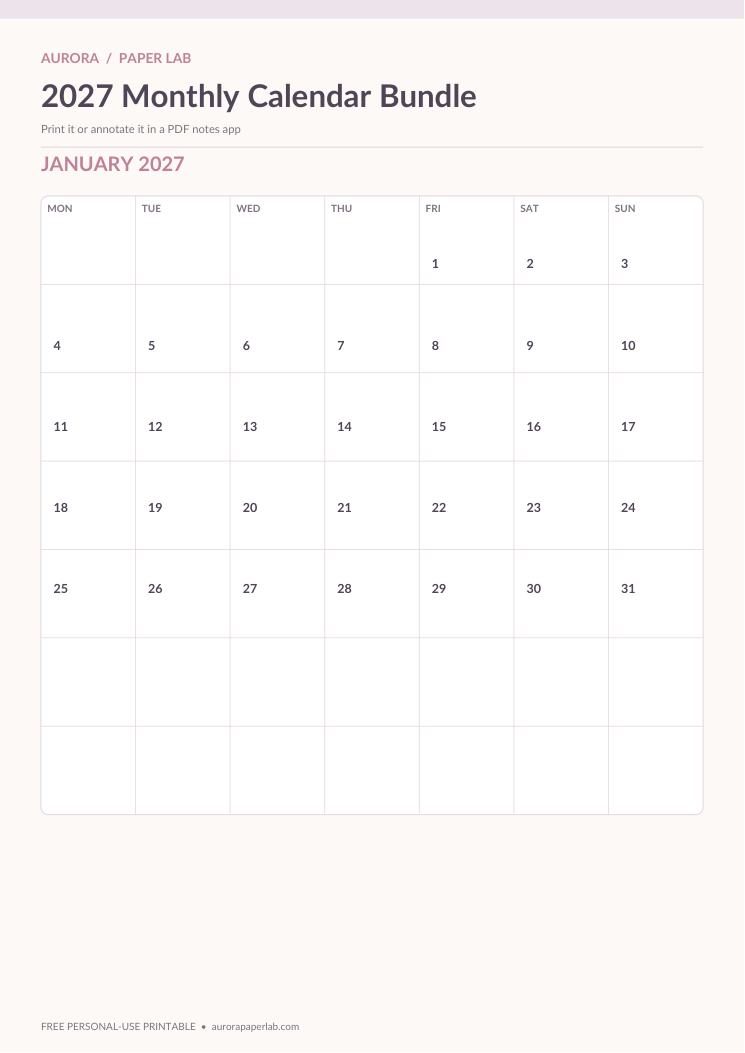
A simple setup might use a Monthly Planner for deadlines, Weekly Priority Board for the next seven days, Grocery List for household planning, and Streak Builder for one habit. That is already a complete system for many people. The example is intentionally simple.
Common mistakes to avoid
The common mistake is adding pages because they look useful rather than because they solve a recurring decision. If a page is not opened for two or three review cycles, remove it from the active planner.
Review and improve the system
Once a month, check which pages you duplicated, which ones stayed blank, and which information you searched for repeatedly. Keep high-use pages, replace low-use pages, and add only one new module at a time.
A realistic example to work from
Imagine you are planning a month that includes work deadlines, household errands, a savings goal and one personal habit. Instead of forcing all four into one dense spread, give each job its own page and connect them through a short weekly review. The monthly page holds dates, the weekly page holds decisions, the finance page holds numbers and the tracker holds repetition. When one part changes, you replace only that module rather than redesigning the entire planner.
A practical quality checklist
- One page has one clear job
- The same date is not copied onto three different pages
- Reference pages are separated from action pages
- A weekly review tells you which module to open next
- Unused pages are removed after two review cycles
- Master PDFs remain untouched so a clean copy is always available
If two or more of these checks repeatedly fail, simplify the workflow before adding another page, app or decorative element.
Problems that usually make this harder than necessary
- Adding decorative pages before the core workflow works
- Duplicating the same task on monthly and weekly pages without a reason
- Keeping inactive trackers because they look complete
- Mixing archive pages with current working pages
These problems have a common pattern: the planner starts asking for more maintenance than the activity itself.
Adapt the method to your situation
- A minimal two-page system for a quiet month
- A project-heavy system with one milestone page per active project
- A household system that combines calendar, meal planning and spending pages
The format can also change over time.
Questions for the next review
At the end of a week, project, trip, reading cycle or other natural review point, answer only the questions that help you decide what to do next:
- Which page did I actually open when I needed to decide something?
- Which information did I rewrite more than once?
- Which page stayed blank and can be removed?
- What single new module would remove the most friction next month?
Define the planning job before adding pages
Start with a yearly overview, one monthly calendar, one weekly page, and one capture page. Write that short baseline before choosing colors, tabs, or decorative elements. A planner is most useful when every page has a specific job and an expected review moment. If a field will never affect a decision, it does not need to be present simply because another template includes it. This first pass also makes size and orientation easier to choose: wide schedules need columns, reflective writing needs open space, and small checklists should not be stretched into dense dashboards.
Use a low-friction setup sequence
For How to Build a Modular Planner from Individual PDF Pages, create or download one clean master, name it with the year and page purpose, and store it somewhere that is included in your normal backup. Test a single real cycle before making a full set. Enter fixed information first, then flexible tasks or notes, and finish with a short review prompt. In a digital app, duplicate the clean page before annotation. For paper, print one sample at Actual Size / 100% and confirm that the writing area, punched margin, and text size are comfortable. The sequence should be simple enough to repeat without a separate instruction sheet.
Make the central decision explicit
The key question is whether a page earns a permanent place by helping you decide, remember, or review something. Put that decision close to the information needed to make it, rather than scattering the evidence across several trackers. Use plain labels and keep optional notes secondary. When two pages compete for the same job, keep the one you open more reliably. When a page contains several jobs, split it only if the combined layout becomes hard to scan. This rule prevents a planning system from growing faster than the routine that supports it.
Worked example
Maya works rotating shifts and originally imported twenty-seven pages. After a two-week test she kept a monthly calendar, a vertical week, a bill tracker, and a notes page. The smaller file opened faster, required less swiping, and still covered every decision she actually made. This is a useful model because the person tests the system with real constraints rather than imagining a perfect week or month. The result is not the maximum number of features. It is the smallest reliable set that captures commitments, supports a decision, and leaves a record that can be reviewed. A practical example should always include what was removed as well as what was kept.
Common mistakes to avoid
- Importing an entire bundle before testing a single week.
- Keeping several layouts that solve the same job.
- Decorating the file before its navigation works.
- Storing the only blank copy inside an annotated notebook.
These how to build a modular planner from individual pdf pages problems usually appear when a planner is treated as a finished product instead of a working tool. Correct them one at a time. Do not rebuild the whole file after one difficult week. A small adjustment preserves useful history and makes it easier to see whether the change actually helped.
Review the system on a fixed cadence
At the end of each month, count which page types you opened and which ones you skipped. Archive completed pages, remove unused sections, and add only one new experiment for the next month. During the review, separate a design problem from an unrealistic plan. A cramped field or unclear label is a design problem. Too many commitments for the available time is a planning problem. The template can solve the first, but only a priority decision can solve the second. Record one lesson in ordinary language so the next version reflects experience rather than guesswork.
Keep printing and digital use consistent
When using How to Build a Modular Planner from Individual PDF Pages, remember that US Letter measures 8.5 × 11 inches and is the safest default for most home printers in the United States. Half Letter measures 5.5 × 8.5 inches and suits compact binders. A4 measures 210 × 297 mm and is common internationally. Use the file that matches the destination paper when possible. If you must scale, test one sheet and check that checkboxes, lines, and margins remain usable. In a PDF annotation app, keep the original ratio; changing only the displayed zoom does not damage the page, while resizing after annotations may move or crop handwriting.
A simple quality check
Before committing to the how to build a modular planner from individual pdf pages layout, answer five questions: Can you find the page in under ten seconds? Is the most important field visible without zooming or unfolding? Does each label mean one thing? Can a blank copy be restored quickly? Is there a clear moment when the page will be reviewed? If any answer is no, simplify the system before adding more content. A dependable planner should reduce repeated decisions and remain understandable after a busy week.